Air monitoring
Published over 13 years ago. See the latest and most current information on Air monitoring.
To accurately determine the percentage Carbon (C), Hydrogen (H) and Nitrogen (N) in highly fluorinated organic compounds, Exeter Analytical Inc. (UK) has developed a reliable analytical method using their Model 440 Elemental Analyser.
Generally compounds containing fluorine can be successfully analysed for percentage CHN content on most elemental microanalysis systems under standard operating conditions. The magnesium oxide in the combustion tube reagent packing absorbs fluorine as HF, and releases the hydrogen. However - highly fluorinated compounds, which are often difficult to combust, can give incorrect carbon and high nitrogen data. This is believed to be due to the strength of the C-F bond. If not fully oxidised, CF2 passes through the combustion tube packing and is detected as nitrogen, resulting in both low carbon and high nitrogen data.
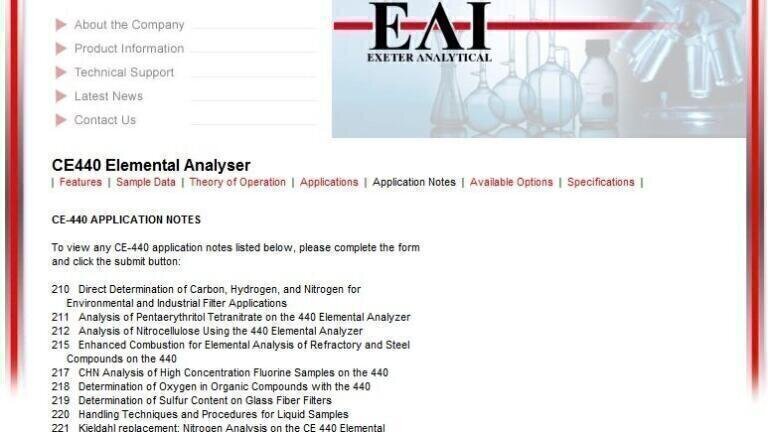
For these highly fluorinated compounds, Exeter Analytical have developed a new reliable analytical method based upon their Model 440 Elemental Analyser that is described in Application Note 217.
For a copy of application note 217 please visit www.exeteranalytical.co.uk/ce440_notes.htm.
Benefiting from a horizontal furnace design, the Exeter Analytical Model 440, allows analysts to routinely produce accurate and precise data on wide ranging sample types without system re-optimisation, saving precious time and reducing running costs.
IET Guide 2026

 Product directory





















.jpg)