Air monitoring
Published over 14 years ago. See the latest and most current information on Air monitoring.
The European Directive 2008/50/EC requires the measurement of nitrogen dioxide (NO2) in all urban areas of more than 100 000 inhabitants. Currently, some of these sites do not meet minimum pre-set quality objectives. Sites located in the vicinity of roads, directly impacted by vehicle emissions are most likely to experience poor air quality.
The reference method for the measurement of nitrogen dioxide (NO2) and oxides of nitrogen (NOx) as described in EN 14211 (2005) is chemiluminescence. This technique is based on the reaction of nitric oxide (NO) with Ozone (O3) and requires high maintenance and has some negative aspects.
Potential errors can arise when measuring the concentrations of NO and NO2 depending on the duration of the measurement cycle. If part of the light energy produced by chemiluminescence is lost in collisions with other molecules present in the sample, such as moisture, under-estimation of the sample may occur. Conversely, a risk of overestimating of NO2 concentrations if other species are converted to NO2 in the NO catalytic oven can occur. Finally there is a degree of error in the conversion efficiency of the furnace.
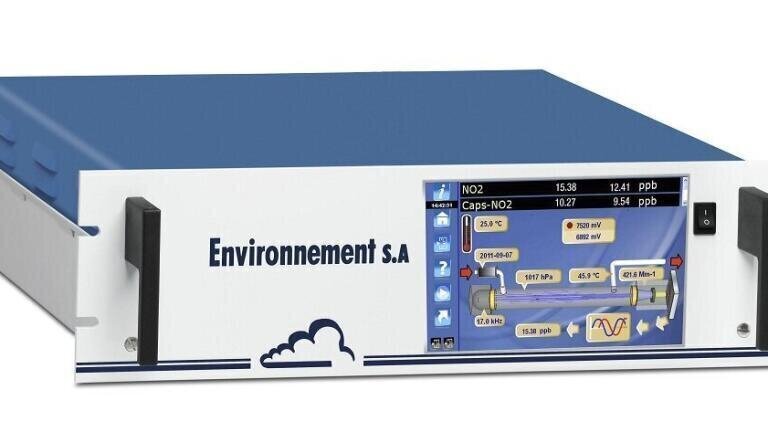
In 2010, to alleviate these potential disadvantages and to provide the most accurate value for NO2 concentration measurements, ADEME (French Environment and Energy Management Agency) supported Environnement SA’s (France) developed an analyser for direct continuous and fast (less than 10 seconds) measurement of NO2. This development, conducted jointly between research university laboratories and Environnement S.A, led to the design of the AS32M analyser. Based on Cavity Attenuated Phase Shift Spectroscopy (CAPS), the analyser is designed to provide fast and accurate measurements. Extremely compact, easy to use and to maintain, the AS32M is equipped with a large touch screen permitting one-touch control of the system as well as pre-configuration of analysis tasks.
IET 36.5 Sept/Oct 2026




 Product directory