Water/wastewater
Published over 11 years ago. See the latest and most current information on Water/wastewater.
For more than 30 years P S Analytical (PSA) has been at the forefront of ultra trace determination of mercury (Hg) and the hydride forming elements such as arsenic (As), selenium (Se) and antimony (Sb) from environmental samples.
The toxic effects of these elements have long been realised and enter the environment from both natural and anthropogenic sources. Wastewater from power generation, petrochemical and plastics production, mining and mineral processing, waste incineration, electronics and semi?conductor fabrication etc. requires rigorous treatment to remove these contaminants prior to legal and responsible discharge to the
environment.
Contaminant removal is clearly the goal but the removal technologies employed require real time (or
online) monitoring capability to ensure effective performance. A particular issue with these toxic elements is the requirement for highly sensitive detection performance ? often at ppb (or lower) concentrations. With online operation, sensitivity is not the only aspect that is critical; sampling frequency and the number of analytical streams required must also be considered, as well as possible sample matrix issues such as high TDS, pH variation, and high levels of particulates.
Equally important to these issues are ones of ease of use, robustness, appropriate online software
capability, affordability of the hardware and ongoing running costs. All of which must be considered in
a holistic approach to the analysis.
Online systems from P S Analytical
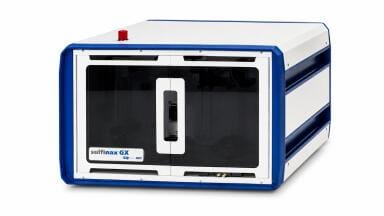
PSA has analysers based on Atomic Fluorescence Spectrometry (AFS) to determine these elements in
environmental samples and offers online analysers to monitor emissions from industrial sources. Employing AFS as a means of detection has many advantages for these determinations. These include; ultra trace limits of detection, a linear response over several orders as well as minimised interferences from other matrix components. PSA’s unique flow cell design, removing troublesome glass or quartz material, provides reduced carryover for faster throughput and less analytical uncertainty. Ease of use, reliability and robustness as well as very affordable running costs are all hallmarks of the PSA brand.With the coupling of the dedicated speciation modules, PSA are able to integrate chromatography and digestion processes to facilitate speciation studies for these elements.
Whether it is in the supply of standard systems or producing specialised systems tailored to users’
specific requirements, the results and sensitivity of our instrumentation has forged our place as
company of choice in the field of online analytical instrumentation. With many systems in the field
today, and support networks in Europe, USA and SE Asia, PSA offers the ideal package of performance,
reliability and support.
IET 36.3 May

 Product directory