Portable & field testing
Published over 8 years ago. See the latest and most current information on Portable & field testing.
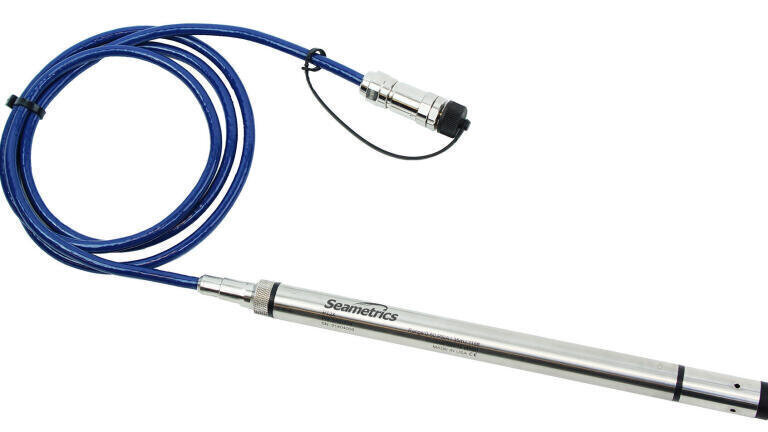
So how does a submersible pressure sensor, like the Seametrics PT2X, work?
Liquids and gasses do not retain a fixed shape. Both have the ability to flow and are often referred to as fluids. One fundamental law for a fluid is that the fluid exerts an equal pressure in all directions at a given level. Further, this pressure increases with an increasing depth of “submergence”. If the density of a fluid remains constant (noncompressible... a generally good assumption for water at “normal” pressures and temperatures), this pressure increases linearly with the depth of “submergence”.
We are all “submerged” in the atmosphere. As we increase our elevation, the pressure exerted on our bodies decreases as there is less of this fluid above us. It should be noted that atmospheric pressure at a given level does vary with changes in the weather. One standard atmosphere (pressure at sea level at 20º C) is defined to be 14.7 PSI (pounds per square inch).
There are several methods to reference a pressure measurement. Absolute pressure is measured with respect to an ideal vacuum (no pressure). Gauge pressure is the most common way we express pressure in everyday life and is the pressure exerted over and above atmospheric pressure. With this in mind, gauge pressure (Pg) can be expressed as the difference between the absolute pressure (Pa) and atmospheric pressure (Patm):
Pg = Pa - Patm.
measure gauge pressure, atmospheric pressure is subjected to one side of the system and the pressure to be measured is subjected to the other. The result is that the differential (gauge pressure) is measured. A tire pressure gauge is a common example of this type of device.
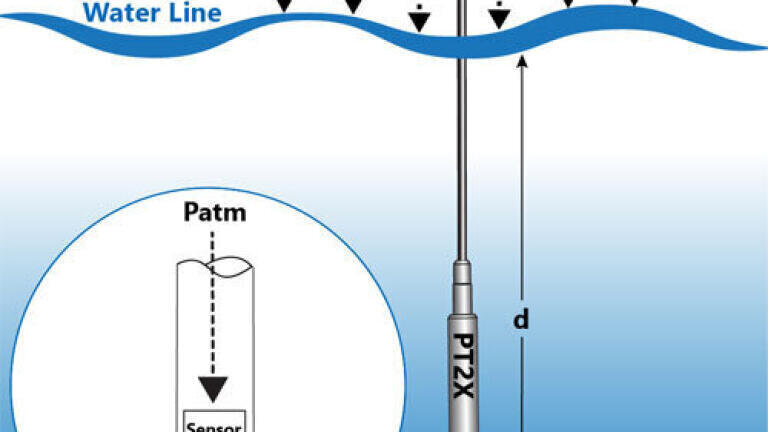
Recall that as the level of submergence increases (in a noncompressible fluid), the pressure increases linearly. Also, recall that changes in weather cause the absolute atmospheric pressure to change. In water, the absolute pressure (Pa) at some level of depth (d) is given as follows:
Pa = Patm + kd
Where k is simply a constant
(i.e.: 2.307 feet of water = 1 PSI)
Seametrics’ standard gauge submersible pressure devices utilize a vent tube in the cable to allow the device to reference atmospheric pressure. The resulting gauge pressure measurement reflects only the depth of submergence. That is, the net pressure on the diaphragm is due entirely to the depth of submergence.
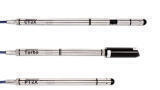
The Seametrics PT2X Smart Sensor is an integrated data logger and pressure/temperature sensor and is ideal for monitoring groundwater, well, tank, and tidal levels, as well as for pump and slug testing. Visit the Seametrics website for more details.
IET 36.5 Sept/Oct 2026



 Product directory