Health & safety
Published over 2 years ago. See the latest and most current information on Health & safety.
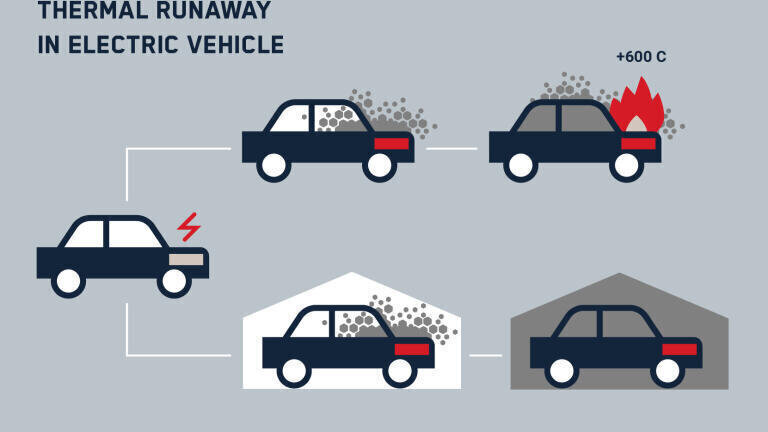
Batteries are designed to store chemical energy, and during thermal runaway, this chemical energy is uncontrollably released. Thermal runaway is characterized by very quick progress, and it can result in the self-destruction of the battery. Gasmet Technologies has an eye on the very heart of battery safety, providing the power of early detection with our gas analysis solutions.
In lithium-ion batteries (LIBs), thermal runaway can be caused by e.g. mechanical damage, external heat, short circuit, or overcharging. In order to study the thermal runaway reaction in Lithium-Ion Batteries, research is being performed on how much different gases, both before and during thermal runaway, are released under different circumstances.
Concentrations of HF and CO might rise already prior to the start of the thermal runaway, thus, following the concentrations of these gases could potentially help prevent risks posed by thermal runaway.
Close to the action, HF concentrations can reach hundreds of ppm, and CO can be in the %–level league. These levels greatly exceed the exposure limits of the components in question, and the air around a battery in thermal runaway can be extremely dangerous to be and breathe in.
Also, fires involving batteries are typically difficult to extinguish, meaning that the fire potentially burns longer causing prolonged risks for both people and the environment nearby. This also requires special knowledge from the first responders.
The portable Gasmet Technologies GT5000 Terra and GT6000 Mobilis gas analyzers provide an ideal solution to be used in different battery safety-related applications. The FTIR technology used provides the possibility to measure all gases of interest simultaneously, saving time with the real-time results and enabling to stay on top of these hazardous situations.
Read more on the article: What is Thermal Runaway in Lithium-Ion Batteries, risks and causes
IET 36.5 Sept/Oct 2026



 Product directory
















.jpg)