Food safety testing
Published over 10 years ago. See the latest and most current information on Food safety testing.
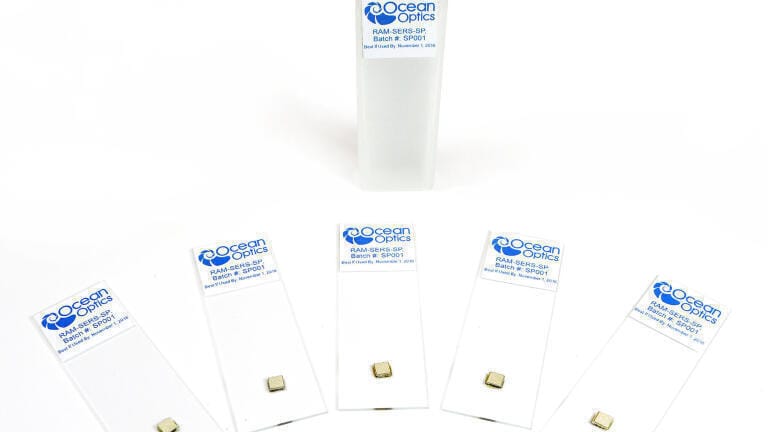
Ocean Optics (UK) has introduced a new substrate for Raman spectroscopy applications. The new RAM-SERS-SP Surface Enhanced Raman Spectroscopy substrates use a proprietary gold-silver nanosponge alloy to produce highly sensitive, trace-level Raman spectroscopy measurements. The applications for SERS range from detection of explosives and narcotics, to food safety, anti-counterfeit tagging and biological research.
SERS substrates amplify very weak Raman signals by many orders of magnitude. Fast, repeatable measurements of SERS-active analytes are possible even to parts-per-trillion levels. Silver-only SERS substrates work best with 532 nm Raman excitation, and gold substrates are better suited to 785 nm Raman systems. By combining the silver and gold on one substrate, the new SERS nanosponge substrates perform well with either wavelength. Also, when used with 638 nm Raman excitation, the nanosponge substrates are enhanced to an even higher level of sensitivity.
RAM-SERS-SP nanosponge substrates are more robust than other options and handle the deposition of sensitive samples more effectively. The higher sensitivity of these substrates opens up new opportunities for SERS applications - particularly in addressing the growing need for fast, effective detection of explosives and pesticides.
The new substrates work with the complete range of Ocean Optics Raman instruments. For users to take full advantage of the RAM-SERS-SP nanosponge substrates’ sensitivity, Ocean Optics now offers 638 nm modular Raman solutions and 638 nm versions of its mini handheld IDRaman spectrometers.
Ocean Optics’ proprietary plasma deposition permits affordable mass production with high repeatability and customisation options. Standard substrates are microscope slide format with a 4 x 4 mm active area. Ocean Optics uses optical-grade borosilicate glass for compatibility with a wide range of solvents.
IET 36.5 Sept/Oct 2026




 Product directory