Environmental laboratory
As PFAS testing expands from environmental waters into food, textiles and consumer products, Shimadzu is helping laboratories combine sensitive mass spectrometry, practical automation and rigorous contamination control.
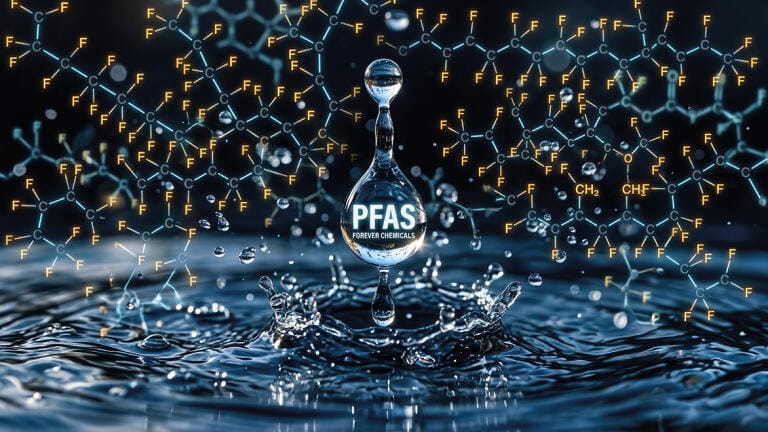
Per- and polyfluoroalkyl substances (PFAS) are among the most challenging groups of contaminants now facing environmental laboratories.
Their ability to repel water, oil and heat has made them useful in a vast range of applications, from performance clothing and food packaging to industrial materials and firefighting foams.
However, those same properties contribute to their persistence in the environment and their ability to move through water, soil, air and supply chains.
Today, laboratories are being asked to look for PFAS in far more than conventional environmental samples.
Drinking water and wastewater remain central areas of focus, but testing increasingly extends to food, textiles, food-contact materials, indoor air and consumer products.
Shimadzu is supporting this wider analytical challenge with an integrated PFAS workflow that combines targeted LC-MS/MS and GC-MS/MS, high-resolution accurate-mass screening, automated sample preparation and practical approaches to contamination control.
Together, these capabilities support reliable trace-level PFAS quantification, from sample preparation to final result.
PFAS testing has traditionally been closely associated with water monitoring, and this remains a critical application.
Methods including US EPA 533, 537.1 and 1633 have reinforced the need for robust, reproducible analysis at increasingly low reporting limits.
However, laboratories now face a much more varied set of PFAS questions.
A drinking-water sample may require highly sensitive targeted analysis of a defined list of ionic compounds.
A treated textile may contain both ionic PFAS and neutral fluorinated substances associated with coatings or water-repellent finishes.
Food samples can introduce proteins, fats and sugars that complicate extraction, separation and detection.
This diversity means there is no universal PFAS method.
Laboratories need the flexibility to choose the right analytical strategy for the compounds of interest, the sample matrix and the regulatory or commercial decision the data will support.
It also means that success cannot be measured solely by an instrument’s sensitivity specification.
Sample preparation, chromatographic separation, matrix management, consumables, background control and quality assurance all affect the integrity of trace-level PFAS results.
Because PFAS vary widely in structure, volatility, polarity and matrix behaviour, laboratories often need more than one analytical technique to build a complete and reliable picture.
Shimadzu’s PFAS-analysis portfolio is designed to address the range of compound classes and sample types encountered in routine and investigative work.
For targeted quantification of known PFAS, triple quadrupole systems such as the LCMS-8065XE provide sensitive LC-MS/MS performance for large PFAS panels across challenging matrices, including drinking water, environmental samples, foods, technical textiles and food-contact materials.
The LCMS-8065XE combines high sensitivity with operational robustness.
Its StreamFocus ESI probe uses a low-diffusion nebuliser nozzle to improve ion intake while reducing droplet dispersion and nebuliser-gas consumption.
The instrument’s IonFocus unit further enhances ion transmission by directing target ions into the mass spectrometer while excluding neutral contaminants, helping reduce contamination-related effects without compromising sensitivity.
This supports reliable, high-throughput PFAS analysis with improved robustness and uptime for long-running laboratory workflows.
Not every PFAS is ideally suited to liquid chromatography.
For volatile or neutral compounds, including fluorotelomer
alcohols, Shimadzu’s GCMS-TQ8050 NX offers a complementary GC-MS/MS option.
This is particularly valuable for textile testing, where a complete chemical profile may require analysis of compounds that would not be fully addressed by a conventional LC-MS/MS workflow.
High-resolution accurate-mass capability completes the analytical picture.
The LCMS-9050 QTOF enables laboratories to move beyond fixed target lists by using accurate-mass measurement and data-independent acquisition for suspect screening and non-target analysis.
This allows analysts to investigate unknown or emerging PFAS and to revisit archived datasets as new compounds or regulatory priorities emerge.
Together, these technologies provide a more flexible response to the complexity of PFAS chemistry.
Textiles and food samples show why PFAS analysis increasingly requires matrix-specific, multi-technique workflows.
In treated textiles, water- and stain-resistant coatings can contain a complex mixture of ionic and neutral PFAS with very different chemical properties.
Applying EN 17681 methods to an aged ski jacket, Shimadzu identified a broad range of compounds, including fluorotelomer alcohols at concentrations above the calibration limit used in the work.
The study also showed how strongly results can depend on extraction conditions.
PFAS embedded within textile coatings may not be fully revealed by older or less suitable extraction approaches, so updated methods are important for obtaining a more representative picture of finished materials.
Food samples introduce a different challenge. Unlike relatively clean water samples, food extracts can contain fats, proteins, sugars and other matrix components that interfere with trace-level LC-MS/MS analysis.
The workflow must therefore remove enough matrix to protect the system and reduce interference, while maintaining good recovery across a diverse PFAS panel.
Shimadzu has addressed this using QuEChERS extraction, online SPE clean-up and stacked injection on the LCMS-8060NX.
In egg samples, the approach enabled quantification of 27 PFAS compounds at ng/mL levels, with strong calibration performance and effective chromatographic separation.
Together, these examples underline a central point: PFAS methods must be designed around the matrix.
A workflow developed for drinking water cannot simply be transferred to food, textiles or packaging without assessing extraction recovery, clean-up efficiency, blank performance, matrix effects and chromatographic behaviour.
As PFAS testing volumes increase, laboratories must improve turnaround times without compromising data quality.
Automation can support both by making repetitive sample-preparation steps more consistent and easier to control.
Shimadzu’s integration with CHRONECT robotic platforms enables automated extraction, clean-up and sample preparation aligned with EPA Method 1633 principles.
By reducing manual handling, laboratories can minimise variation between analysts, batches and preparation days.
For PFAS analysis, automation is more than a throughput tool; it is also a quality tool.
Controlled solvent addition, mixing, extraction and clean-up help standardise preparation across large sample sets, allowing analysts to focus on data review, unexpected results and quality assurance.
Even the most sensitive mass spectrometer cannot fully compensate for inconsistent extraction or uncontrolled sample preparation.
Reliable PFAS workflows therefore depend on both instrument performance and reproducible front-end processing.
PFAS analysis has a unique complication: the analytes of interest may also be present in the laboratory environment.
Solvent lines, caps, septa, filters, tubing, glassware and even laboratory dust can contribute background signals.
At low-ng/L or pg/L concentrations, contamination control is as important as analytical sensitivity.
1. Begin with clean mobile phases
Mobile phases and reagents are potential sources of avoidable background contamination.
• Use LC-MS-grade or dedicated PFAS-grade solvents and reagents.
• Where practical, prepare mobile phases from newly opened solvent bottles and replace prepared mobile phases at least once a week.
• For ultrapure-water systems, discard the first approximately two litres before collecting water for LC use, while following the water-system manufacturer’s guidance.
• Wipe benches, bottles and preparation tools with methanol or another suitable organic solvent before use.
• If airborne contamination is suspected, prepare mobile phases in a cleaner room or laminar-flow hood.
• Keep solvent bottles tightly sealed using fittings that minimise evaporation and the ingress of contaminants.
2. Use dedicated and conditioned glassware
Glassware should be reserved for PFAS work and thoroughly cleaned before it enters the workflow.
A practical conditioning sequence is:
• Rinse mobile-phase bottles two or three times with isopropanol, ensuring necks and inlets are washed thoroughly.
• Where higher background persists, fill bottles with a 1:1:1:1 mixture of water, methanol, acetonitrile and isopropanol.
• Sonicate for 10 minutes.
• Generate and discard approximately two litres of fresh ultrapure water.
• Fill the bottles with this water, loosely cap and sonicate for a further 10 minutes.
• Discard the water, then pre-rinse bottles two or three times with the intended mobile-phase solvent before preparing fresh mobile phase.
This process can substantially reduce the risk of PFAS leaching from glassware into solvents or standards.
3. Protect samples during storage and preparation
Careful selection of sample containers and preparation materials helps avoid introducing artefacts before analysis.
• Use containers that have been verified as suitable for PFAS analysis, such as appropriate polypropylene tubes or selected amber-glass vials.
• Seal containers tightly and store samples frozen where appropriate to minimise degradation and adsorption.
• Aim to analyse prepared samples within one week.
• For extended autosampler-vial storage, consider transferring samples into fresh vials with new caps before analysis. A punctured septum can become a contamination route.
• Clean benches, pipettes and preparation tools with methanol before use.
• Use polypropylene or glass containers that do not contain fluoropolymers when holding solvents, standards or sample extracts.
• Rinse containers with methanol two or three times before they contact standards or samples.
• If recurring contamination appears connected to the preparation area, move PFAS work to a separate, cleaner workspace.
4. Use a delay column to manage system background
A delay column installed between the LC gradient mixer and autosampler can help distinguish system-derived PFAS from sample-derived compounds.
• PFAS leached from PTFE solvent lines and the degasser are retained on the delay column during low-strength mobile-phase conditions.
• As the gradient strengthens, these background PFAS elute as a distinct peak later in the chromatogram, well away from early-eluting target analytes such as PFBA and PFPeA.
• This allows laboratories to retain the convenience and robustness of a standard LC configuration, rather than replacing fluoropolymer components.
If the delay column itself is suspected as the source of background:
1. Remove the analytical column, leaving only the delay column in line.
2. Direct LC flow to waste, or use a switching valve to bypass the mass spectrometer.
3. Flush the delay column with methanol for one to two hours at the routine method flow rate.
4. Re-equilibrate with mobile phase before returning to routine analysis.
5. Deep-clean when background remains high
Persistent background may require more intensive cleaning of the LC system and MS interface.
For the LC flow path:
• Disconnect the line between the analytical column and MS, then direct it to waste.
• Use a flow restrictor or sacrificial column to maintain suitable pump pressure.
• Flush line A or B with isopropanol for at least 12 hours.
• If necessary, flush both lines with a 1:1:1:1 water/methanol/acetonitrile/isopropanol mixture containing 0.1% formic acid for at least 12 hours, followed by a further isopropanol flush.
For the MS interface:
• Use delay and analytical columns that already show low background.
• Set the interface temperature to the maximum recommended value.
• Pump the mixed cleaning solvent containing 0.1% formic acid for at least 12 hours.
These measures help remove PFAS and other contaminants from metal surfaces, tubing and the ion-source region, restoring a cleaner baseline for trace analysis.
PFAS will remain a long-term environmental, regulatory and public-health concern, with monitoring now extending across water, food, consumer products and industrial materials.
Laboratories therefore need workflows that are sensitive, adaptable and dependable.
Shimadzu’s PFAS platform combines targeted LC-MS/MS, GC-MS/MS for volatile and neutral compounds, high-resolution QTOF screening and automated sample preparation.
Its workflow approach also supports control of the full analytical process, including consumables and laboratory practices that can influence background levels.
From textiles and food packaging to drinking water and breakfast eggs, reliable PFAS data help laboratories support compliance, product stewardship, environmental research and public-health protection - turning a complex chemical challenge into confident scientific insight.
IET Guide 2026

 Product directory





.jpg)










.jpg)





.jpg)