Water quality monitoring
In a recent expert lecture now available on the Envirotech platform, sensor specialist John Attridge from Chelsea Technologies addressed one of the most critical challenges in environmental water monitoring: achieving accurate, standardised fluorescence measurements in the face of real-world complexity.
With over 60 years of experience developing environmental and marine monitoring technologies, Chelsea Technologies is no stranger to the difficulties that come with high-sensitivity optical sensing.
This session focused on fluorescence-based measurements and their powerful ability to detect trace compounds, including hydrocarbons and biological markers, at sub-part-per-billion levels.
But the sensitivity of these sensors brings challenges. “Before we can even begin to set thresholds for environmental monitoring, we must address three key barriers; lack of standardisation, environmental interferences and spectral overlaps,” explained John.
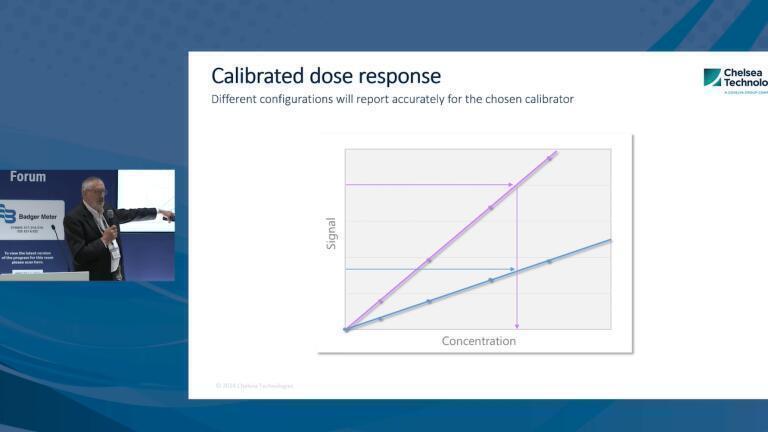
The talk highlighted how differences in sensor configuration - like geometry and excitation/emission wavelengths - can lead to vastly different results between sensors measuring the same sample.
To combat this, John, along with his team, has developed a quinine sulphate-based standardisation method. This allows for cross-compatibility and absolute fluorescence measurements across different sensor designs.
Environmental interferences such as turbidity and absorbance were also addressed. These factors can suppress fluorescence signals, leading to inaccurate data.
By applying correction algorithms based on simultaneous turbidity and absorbance measurements, sensor outputs can be reliably linearised - even in tough environments like sewage treatment plants.
John concluded with compelling examples of how multispectral readings and ratio-based analysis can isolate real events from false positives caused by background noise - critical for maintaining trust in automated monitoring systems.
Sign in now to watch the full lecture and explore the technology reshaping water quality monitoring.
Coming soon: AQUAMATE – the new international exhibition series dedicated to water and wastewater monitoring.
Don’t miss AQUAMATE India (10-12 March 2026) and AQUAMATE Asia (17-19 November 2026).
Learn more and register your interest today:
IET Guide 2026

 Product directory












.jpg)