Water/wastewater
Increasing needs to optimise energy use, prevent system failures, and enhance efficiency is now being met with powerful AI-driven analytics, Klarion explains.
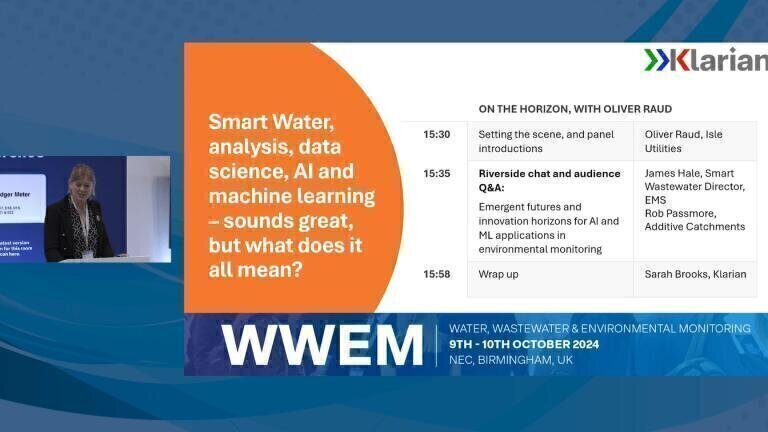
Artificial intelligence (AI) and data science are transforming how the water sector approaches its most pressing engineering and operational challenges.
Dr Liam Trime, head of analytics at Klarion, outlined how the water sector can leverage lessons from more mature industries like oil and gas. Here dense instrumentation has long supported data-rich operational models.
With the UK's water sector facing growing public and regulatory pressure, particularly around infrastructure failures and energy use, there’s a push to unlock the potential of recently installed sensors and real-time monitoring systems.
At the core of Klarion’s approach is “hybrid AI” – blending rigorous engineering models with statistical and machine learning methods.
This dual-pronged strategy allows them to create accurate digital twins of physical systems. This enables predictive maintenance, fault detection, and performance optimisation.
A key innovation includes AI-generated “virtual sensors,” which mimic real sensor outputs and serve as backup in case of sensor failure.
These models help utilities optimise entire pipeline systems by treating them as interconnected machines.
They can identify inefficiencies in pumping operations, recommend reconfiguration routes, and even highlight where energy waste is occurring. Sometimes uncovering six-figure annual losses due to unnoticed faults.
In one case, the system revealed that a motor was operating without being connected to a pump for nearly 1,000 hours. This cost a utility £100,000 in unnecessary electricity use.
The benefits extend beyond operations.
Klarion’s tools also support business decisions, such as justifying investments in variable speed drives to replace throttling practices, with rapid returns on investment.
Ultimately, the talk underscored that data science is only as powerful as its implementation.
Trusted partnerships, collaborative development, and a clear understanding of operational needs are essential for AI to deliver real-world value.
IET Guide 2026

 Product directory







.jpg)








.jpg)
.jpg)
.jpg)
.jpg)

.jpg)