Water monitoring
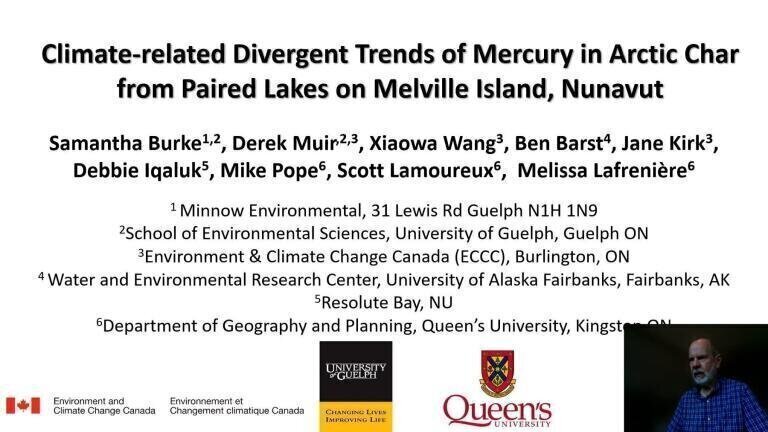
In this presentation, Derek Muir from Environment and Climate Change Canada introduces a study conducted at the Cape Bounty Arctic Watershed Observatory on Melville Island, in collaboration with co-authors Samantha Burke and Scotland Road.
The research investigates the effects of permafrost degradation on contaminant fluxes – specifically turbidity and mercury transport – into High Arctic lakes.
The Cape Bounty site comprises multiple small watersheds, including East and West Lakes, which exhibit contrasting conditions.
West Lake, more severely impacted by thawing permafrost and active layer detachment slides, has experienced increased turbidity due to aqueous slumps and sediment-laden inflows during snowmelt and rain events.
These disturbances are visibly marked by murkier waters compared to the clearer East Lake.
The study draws upon 10 years of environmental data, analysing suspended sediment and mercury fluxes in the east and west rivers feeding the lakes.
Results show that west river carries significantly higher sediment and mercury loads than east river.
This discrepancy is linked to enhanced landscape disturbance in the west lake catchment, including saturated clay flows and visible terrain deformation.
Moreover, mercury bioaccumulation in fish was examined, revealing higher mercury concentrations in west lake compared to reference sites.
The findings suggest a strong relationship between catchment instability, sediment transport and contaminant delivery to aquatic ecosystems.
The research underscores the growing concern that climate-induced permafrost thaw could increase contaminant mobility in Arctic freshwater systems.
As the Arctic continues to warm, monitoring programs and adaptive environmental policies will be essential to mitigate the ecological consequences of these changes.
IET Guide 2026

 Product directory
















.jpg)