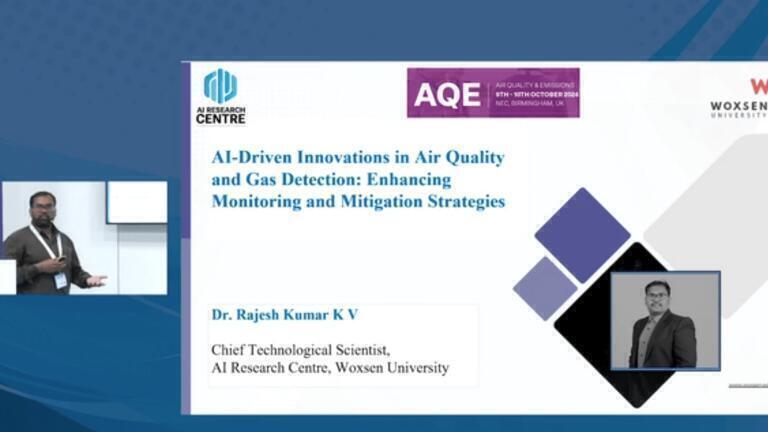
In this video, Dr Radish Kumar, an information systems professor from India, delivers an engaging lecture on how artificial intelligence (AI) is driving innovation in air quality monitoring and gas detection.
His talk highlighted the integration of AI-powered tools with sensor technology, offering predictive analytics to monitor, detect, and mitigate pollution in real time.
Dr Kumar emphasized the limitations of traditional air quality sensors, which provide raw data. However, the often require manual processing to extract meaningful insights.
In contrast, AI-enabled sensors utilize machine learning algorithms and edge computing to identify anomalies and deliver actionable data instantly. This approach not only streamlines monitoring but also enhances accuracy and efficiency.
A key area of focus was the development of predictive models. By leveraging historical and real-time data, AI algorithms can forecast pollution trends and identify potential hazards before they escalate.
Dr Kumar explained that generative AI, such as Generative Adversarial Networks (GANs), can simulate environmental conditions and create virtual scenarios to test mitigation strategies.
Practical applications of AI in air quality management include drone-based monitoring for hazardous gases, smart city integration, and anomaly detection for gas leaks. These innovations are particularly critical in highly polluted regions across Asia, where AI tools can provide scalable solutions to monitor and address emissions effectively.
Dr Kumar concluded with a forward-looking vision: integrating AI, IoT, and advanced sensor technology to create proactive monitoring systems capable of reducing carbon emissions while supporting economic growth.
By combining hardware advancements with AI algorithms, real-time environmental monitoring can evolve into a robust, predictive tool for policymakers, regulators, and industries alike.
The session underscored AI’s transformative role in addressing global air quality challenges.
Watch the full lecture video, exclusively on Envirotech Online.
IET Guide 2026

 Product directory














.jpg)
.jpg)
.jpg)
.jpg)