Environmental laboratory
Published over 11 years ago. See the latest and most current information on Environmental laboratory.
NIVUS GmbH (Germany) now using hydrophone test bench for the development
of new ultrasonic sensors
The NIVUS flow meter experts have developed a hydrophone test bench in close cooperation with the University of Ulm. Utilising the possibility to make ultrasonic waves virtually visible, the manufacturer in the future is able to optimise sensors regarding the signal efficiency. The goal is to achieve higher measurement accuracies from the same amount of energy.
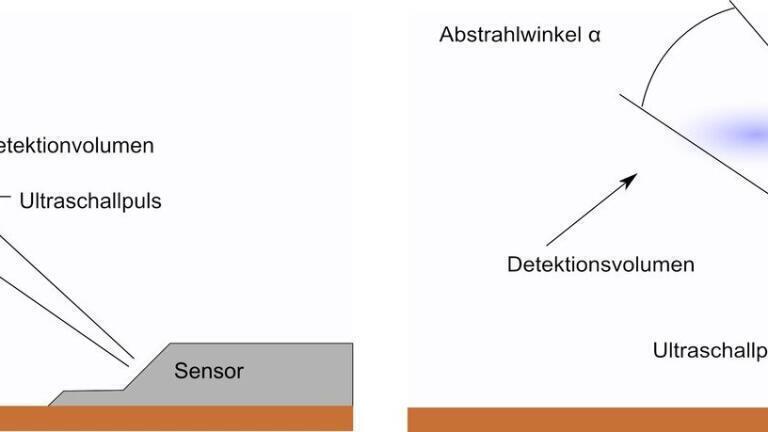
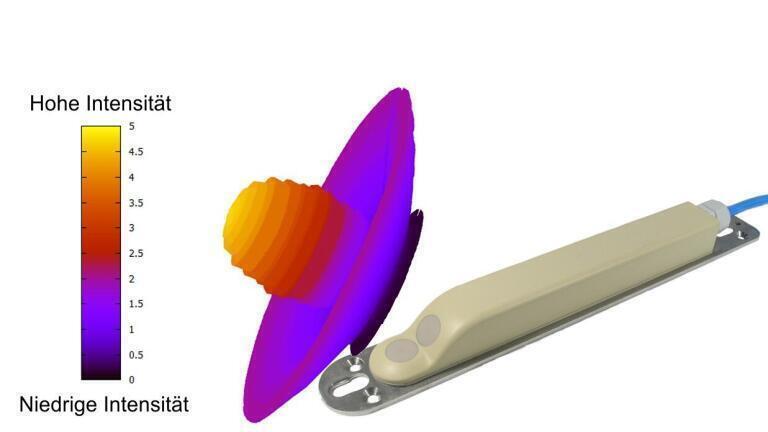
Ultrasonic flow measurement is based on the emission of acoustic waves into flowing media. Possible applications and measurement accuracies depend on the qualities of the ultrasonic converter generating the waves. Here mainly the directional characteristics or the radiation patterns are crucial. The narrower the beam angle the better the wave can be localised. In this case the path of the wave is well defined and the probability of interferences due to reflections or scattering is significantly reduced (see Fig. 1). The result is a higher intensity of the wave without increasing energy consumption which moreover improves the signal behaviour of the sensor.
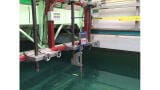
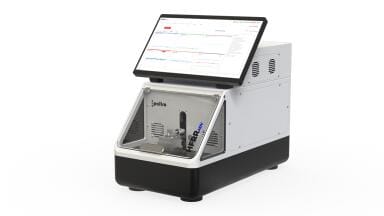
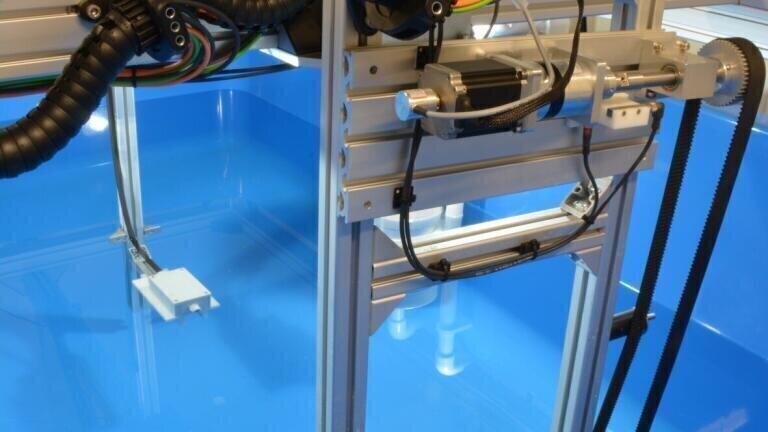
The radiation behaviour of ultrasonic instruments can be measured by using a hydrophone test bench (Fig. 2). This test bench essentially consists of a hydrophone to detect the ultrasonic waves within the medium, an orthogonal, motorised positioning system for precise instrument alignment and a fixation for the units to be tested. Hydrophone and sensor are immersed into a tank containing purified water. The flexible construction allows to align the sensor as required and to simultaneously measure the intensity of acoustic waves emitted by the ultrasonic instrument. This results in a two-dimensional image of the wave front generated by the instrument which then can be compared with previously calculated computer models (Fig. 3).
Overall, combining computer models and the hydrophone test bench provides an ideal tool to optimise and to develop new very accurate ultrasonic instruments. Dr. Asmorom Kibrom of the NIVUS R&D department says: "The test rig enables the measurement and the visualisation of ultrasonic waves and constitutes the groundwork for the development of efficient flow sensors".
IET 36.5 Sept/Oct 2026



 Product directory