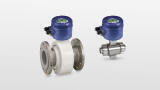
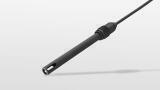
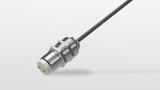
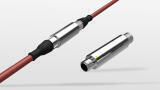
The BlackLine conductivity cells from JUMO (Germany) have been used successfully for many years in the processing of wastewater,
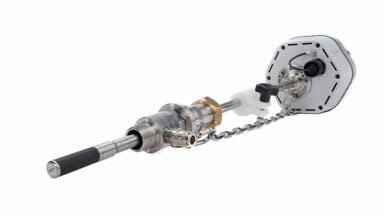
service water and drinking water. New items in the JUMO range are the LF-4C conductivity cells, which function on the 4-electrode
principle. This technique opens up areas in which one could previously only use systems without electrodes i.e. inductive measurement.
These new cells are fitted with two pairs of stainless steel electrodes. One pair measures the current that flows through the solution under test, the second pair measures the voltage applied to the solution.
The integrated Pt1000 temperature probe measures the temperature of the medium, and can be used for the temperature compensation of the conductivity signal.
When 2-electrode cells are used, five different cell designs are necessary to cover the range up to 200mS/cm. With the new 4-electrode cells, only one cell is required to be able to make measurements over a range from about 5ìS/cm up to 500mS/cm. Another advantage is that such cells are insensitive to errorcausing resistances, such as those caused by long connecting cables, dirt or polarization.
This means that these cells are ideal for application in the processing of service water and drinking water, HVAC engineering, wastewater treatment and ion-exchange equipment.
 Product directory