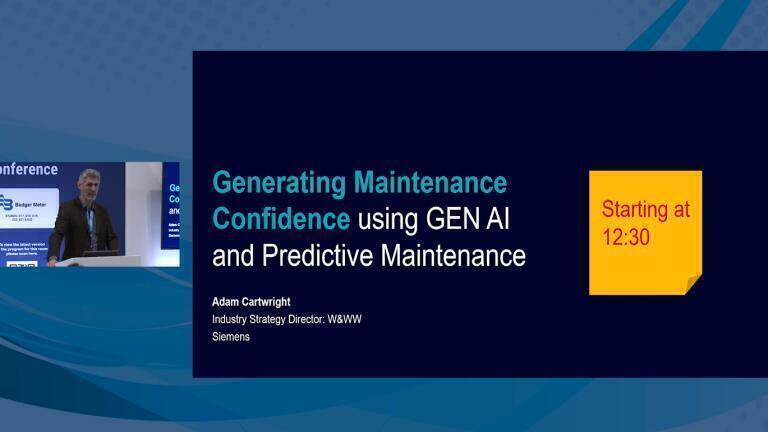
Generative AI is revolutionizing industries worldwide. Its potential applications in environmental monitoring and maintenance were highlighted in this thought-provoking lecture.
The session explored how generative AI can enable water companies and maintenance teams to enhance their operations, while addressing growing challenges.
The speaker began by emphasizing the pressing demands on water companies. Demands such as meeting stringent operational efficiency targets and reducing reactive maintenance costs.
For example, United Utilities aims for a 20% reduction in reactive maintenance expenses by shifting to proactive strategies. This aligns with a broader goal: leveraging digital technologies and advanced analytics to manage assets more effectively, reduce risks, and minimize costs.
Three critical challenges faced by maintenance teams were highlighted:
Dashboards versus insight: despite having access to numerous data dashboards, maintenance professionals often lack actionable insights. The influx of sensor data from machinery is often overwhelming without the tools to interpret it effectively
Knowledge retention: the 'silver tsunami' of retiring experts is causing a significant loss of tacit knowledge about assets, leaving gaps in operational expertise
Collaboration barriers: sharing best practices across teams remains a hurdle, limiting the ability to scale effective solutions.
Generative AI offers a transformative approach to these challenges.
By integrating it with predictive maintenance systems, teams can make complex analytics accessible and actionable.
A live demo showcased a tool powered by Siemens' Senseye Predictive Maintenance, where users interact with AI-driven insights in natural language.
This bridges the gap between complex data and actionable solutions, empowering staff at all skill levels to respond efficiently to maintenance alerts.
Other industries have demonstrated the value of generative AI in maintenance.
Examples included a global automotive manufacturer reducing downtime by 50% and achieving a return on investment in under three months. As well as a steelmaker utilizing existing data to predict asset issues.
These examples underline that similar technologies can be applied to the water industry, offering scalability and cost-efficiency.
The lecture laid out a clear roadmap for water companies to adopt generative AI:
Adam Cartwright emphasized the importance of employee buy-in. He cites instances where condition monitoring tools were underutilized due to inadequate user training or integration into workflows.
Generative AI not only improves operational efficiency but also supports sustainability. By optimizing maintenance schedules and reducing unnecessary travel, it helps companies lower their carbon footprint.
Watch the full lecture video above. Available exclusively on Envirotech Online.
IET Guide 2026

 Product directory




.jpg)








.jpg)
.jpg)
.jpg)
.jpg)


.jpg)
