These BMSS sessions were recorded at WWEM 2014 and are now being made available to all those who were not able to make the presentations in person. Not all the presentations have been captured from the day, and some presentations were not given approval for online learning distribution.
The Program for this eLearning session is as follows,
Registration will be able to claim Continuing Professional Development (CPD) time for the event’s Conferences, Forums and Workshops. WWEM organiser Marcus Pattison says: “This is great news for the event because it provides formal recognition of the value of the many learning experiences at WWEM and provides delegates with reassurance that their visit will be worthwhile.”

Talking on the topic of - Detection of explosives throughout the wastewater system: implications for environmental surveillance. Sally Gamble is a PhD student at the Department of Security and Crime Science with a concentration in environmental surveillance for forensic intelligence at the Centre for the Forensic Sciences at University College London. Her research interests include the spatial and temporal distribution of trace evidence, such as explosives, in the wastewater system and how related forensic evidence can be applied to counter-terrorism and criminal investigations. More specifically, her work examines methodologies for the use of trace explosives detected in the natural environment for the identification of clandestine laboratories for the manufacture of improvised explosive devices.
Use of mass spectrometry for the analysis of environmental contaminants. In this presentation the recent advances in mass spectrometry technology will be discussed. Using both liquid and gas chromatographic separation techniques the sensitivity, selectivity and quantification capability for multi- residue analysis of environmental contaminants will be demonstrated.
Screening for unknown substances in complex mixtures using chromatography and MS. A strategy is presented to apply non-targeted gas and liquid chromatographic approaches, in conjunction with time-of-flight MS techniques, to achieve relevant limits of detection sensitivity and identification of constituents of potential toxicological concern.
Detection and quantitation of ultra-trace organic residues in water using LC/MS/MS. In this presentation we show how two complimentary Liquid Chromatography-Mass Spectrometry technologies (LC-MS/MS ) can be deployed to provide comprehensive screening and quantitation of these compounds in water. The application of both nominal mass and high resolution, accurate mass LC-MS/MS systems will be discussed.
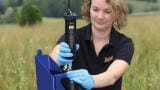
Enhanced screening of environmental pollutants in water by GCxGC - TOF MS with soft electron ionisation. Passive sampling devices (e.g. semi-permeable membrane devices (SPMD), LDPE and silicone rubber) are often used for routine monitoring of water quality. The samplers were deployed for several weeks in a polluted river course in the UK to effectively sequester large volumes of water and provide a concentrated, representative extract for analysis by GCxGC-TOF MS with Select-eV. In this study, we show the suitability of this novel analytical platform for the analysis of both target pollutants and unknown chemicals in water.

Since retirement in 2000, I have acted as the coordinator of the Environmental Mass Spectrometry Special Interest Group (EMSSIG) for The BMSS and have organised 7 meetings of this group since 2004. The group name has recently been changed to the Environmental and Food Analysis Group (EFASIG) to incorporate aspects of food analysis. The most recent meeting of the group on November 5, 2014 was organised as part of the WWEM2014 conference at Telford. I was a sessional chair and also a presenter at the Analytica Acta-2013 conference on Analytical and Biochemical Techniques in Las Vegas, October 15-17, 2013 and I am currently acting as an adviser to the organising committee for Analytica-2015, Valencia, Spain in September, 2015.
IET Guide 2026

 Product directory













.jpg)
.jpg)
.jpg)
.jpg)